South Africa’s automotive industry has entered 2026 on a strong footing, with January sales figures confirming that the momentum of 2025 is being sustained.
The Automotive Business Council (naamsa) reports that both domestic and export sales registered gains, reflecting resilience in consumer demand and stability in broader economic conditions.
Domestic Sales Growth
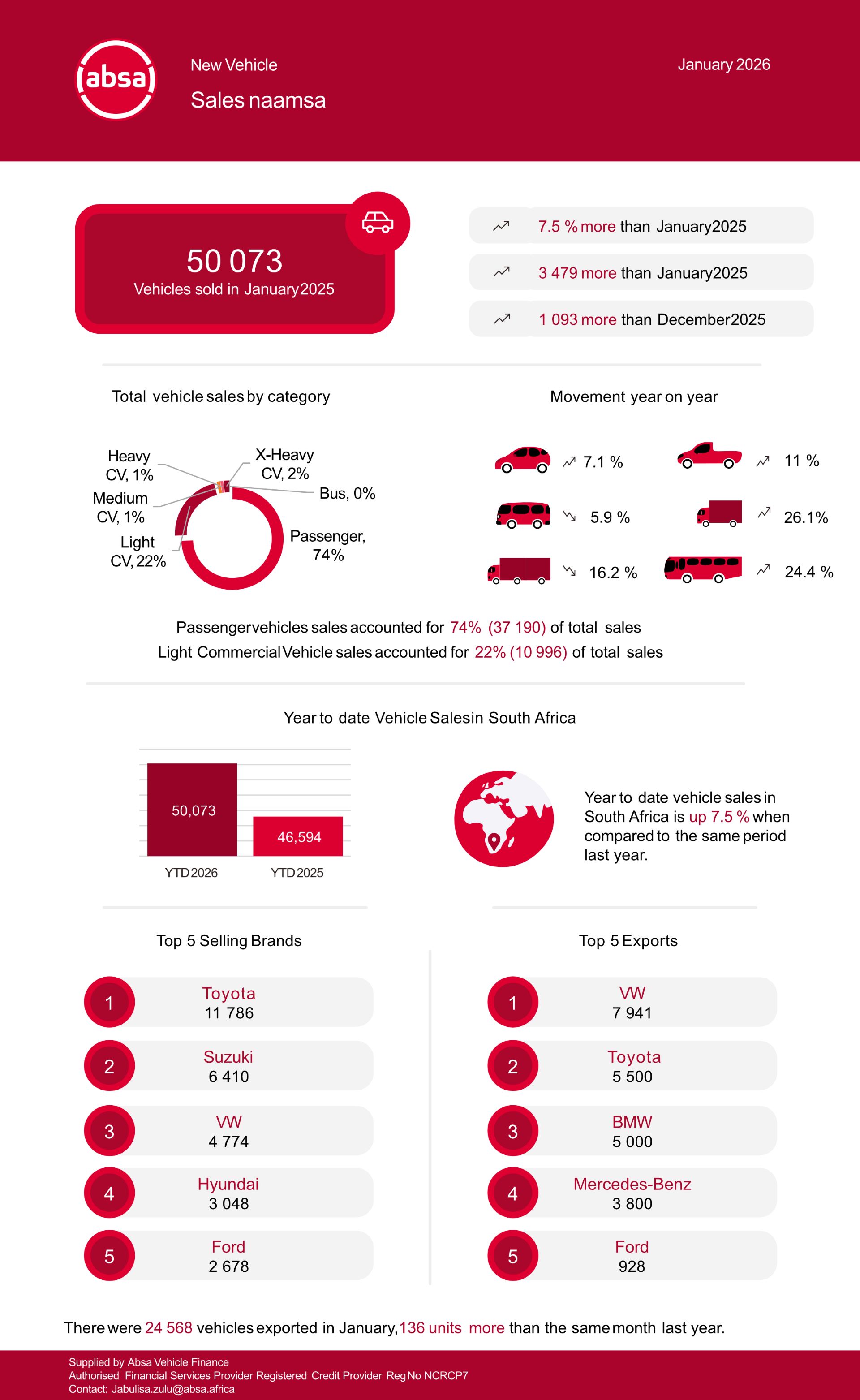
Aggregate new vehicle sales in January 2026 reached 50 073 units, an increase of 3 479 vehicles or 7.5% compared with the 46 594 units sold in January 2025. Of this total, dealer sales accounted for 42 753 units, representing 85.4% of the market. Rental companies contributed 10.9%, corporate fleets 2.1%, and government 1.6%.
Passenger car sales rose to 37 190 units, a year‑on‑year increase of 7.1%. Car rental sales made up 13.3% of this segment. Light commercial vehicles also performed strongly, with 10 996 units sold, up 11% compared with January 2025. Naamsa observed that demand for light commercial vehicles continues to mirror conditions in the goods‑producing sectors, which remain constrained but show signs of gradual stabilisation.
Mixed Performance in Commercial Segments
Medium commercial vehicle sales fell by 5.9% to 542 units, while heavy trucks and buses declined by 4.3% to 1 345 units. Naamsa noted that fleet replacement decisions remain closely tied to infrastructure investment, logistics performance, electricity costs, and confidence in the broader investment outlook.
Export Sales and Global Challenges
Vehicle exports in January 2026 reached 24 568 units, a modest increase of 0.6% compared with the same month last year. Naamsa highlighted that export performance was supported by currency stability and easing input costs, but cautioned that rising protectionism in key markets poses risks. “The proliferation of trade‑restrictive measures and evolving industrial policies in advanced economies continue to test South Africa’s automotive export competitiveness,” the organisation stated.
Policy Outlook
Looking ahead, naamsa emphasised the importance of finalising the comprehensive review of South Africa’s automotive policy framework. In a global environment marked by technological disruption, shifting trade alliances, and energy transition, a coherent and forward‑looking policy is seen as critical to securing South Africa’s position in regional and global value chains.
Staff Writer
Reporting from the front lines of the automotive industry, delivering expert analysis and the technical updates that drive the South African motor sector forward.