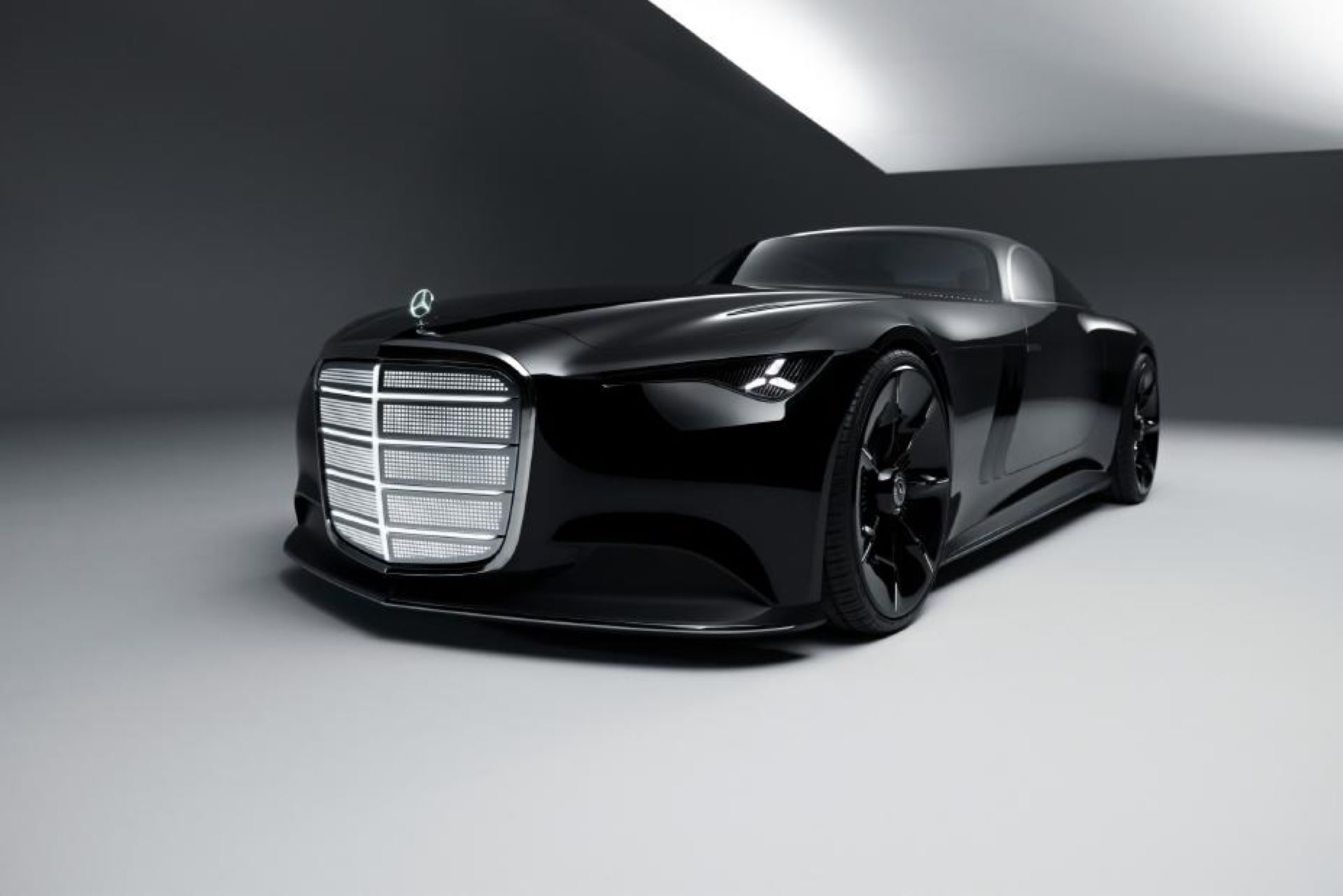
Mercedes-Benz has developed an invisibly thin solar film that could fundamentally change how electric vehicles capture and store energy. Featured on the automaker's recently unveiled Vision Iconic concept, this microscopic coating represents a significant leap forward from traditional automotive solar integration.
The innovation centers on an extraordinarily slim photovoltaic layer—just 5 micrometers in thickness—that adheres directly to vehicle body panels beneath the exterior paint. This transparent coating essentially converts the car's entire outer shell into a continuous power-generating surface while remaining completely hidden from view.
The technology's environmental credentials are equally impressive. Mercedes has eliminated the need for silicon and rare-earth elements typically required in conventional solar panels. Instead, the coating employs nanoparticle-based materials specifically engineered for recyclability. The accompanying jet black topcoat allows an exceptional 94 percent of sunlight to reach the energy-capturing layer underneath.
This flexible film adapts to different surface materials and geometries, functioning continuously whether the vehicle is driving, parked, or completely shut down—potentially delivering meaningful range extensions based on geographic location and weather patterns.
Performance projections suggest considerable potential. Mercedes calculates that covering approximately 11 square meters—the typical surface area of a midsize crossover—could yield enough solar energy to power 12,000 kilometers of driving annually in Stuttgart's moderate climate. California's abundant sunshine could push that figure to 20,000 kilometers in Los Angeles.
The development addresses long-standing challenges in automotive solar integration. "While solar technology on vehicles has been explored before, we're expanding the boundaries of practical application," said Jochen Schmid, Mercedes-Benz senior manager for future electric drive, speaking with Automotive News Europe.
The critical advancement involves the material's adaptability. "We've created a coating that stretches and bends to accommodate complex three-dimensional vehicle surfaces," Schmid explained. "This flexibility represented our major technical achievement."
Manufacturing scalability remains a priority. Schmid's engineering team is refining application techniques that maintain cost-effectiveness without compromising quality. "Considerable research continues because adding €10,000 to vehicle pricing would eliminate the total ownership benefits for consumers," he cautioned.
Future iterations may offer expanded aesthetic options. The technology can potentially accommodate colored finishes—including blue, red, and green—through light-filtering techniques while preserving most power-generation capacity. However, efficiency varies with color intensity.
"Transitioning from black to blue typically reduces performance around 5 percent," Schmid indicated. "White finishes would sacrifice the most efficiency."
This development aligns with Mercedes-Benz's strategic initiative to maximize energy efficiency and environmental responsibility across its next-generation electric vehicle lineup, potentially establishing new benchmarks for sustainable automotive technology.
The Vision Iconic concept also incorporates Level 4 autonomous driving systems and steer-by-wire technology, though the solar coating innovation may prove most transformative for practical everyday electric vehicle operation.
Staff Writer
Reporting from the front lines of the automotive industry, delivering expert analysis and the technical updates that drive the South African motor sector forward.