Toyota has taken a bold step in redefining automotive sustainability with the announcement of its newest Circular Factory in Walbrzych, Poland.
Covering 25,000 square metres and designed to process around 20,000 end-of-life vehicles each year, the facility marks a major expansion of Toyota’s European circularity strategy.
What sets this move apart is Toyota’s decision to accept vehicles of any brand. The goal is simple but ambitious: recover as many valuable materials as possible and channel them back into new production cycles. Batteries and wheels will be assessed for remanufacturing, repurposing or full recycling, while metals such as copper, steel and aluminium, along with various plastics, will be extracted and reused in the manufacture of future Toyota vehicles.
This facility represents Toyota’s second Circular Factory in Europe, following the opening of its first site in Burnaston in the United Kingdom in 2025. Both plants embody Toyota’s broader reduce-reuse-recycle framework, which aims to cut emissions, strengthen supply chains and reduce reliance on carbon-intensive raw materials. As the company puts it, circularity is both a pathway to and an enabler of carbon neutrality.
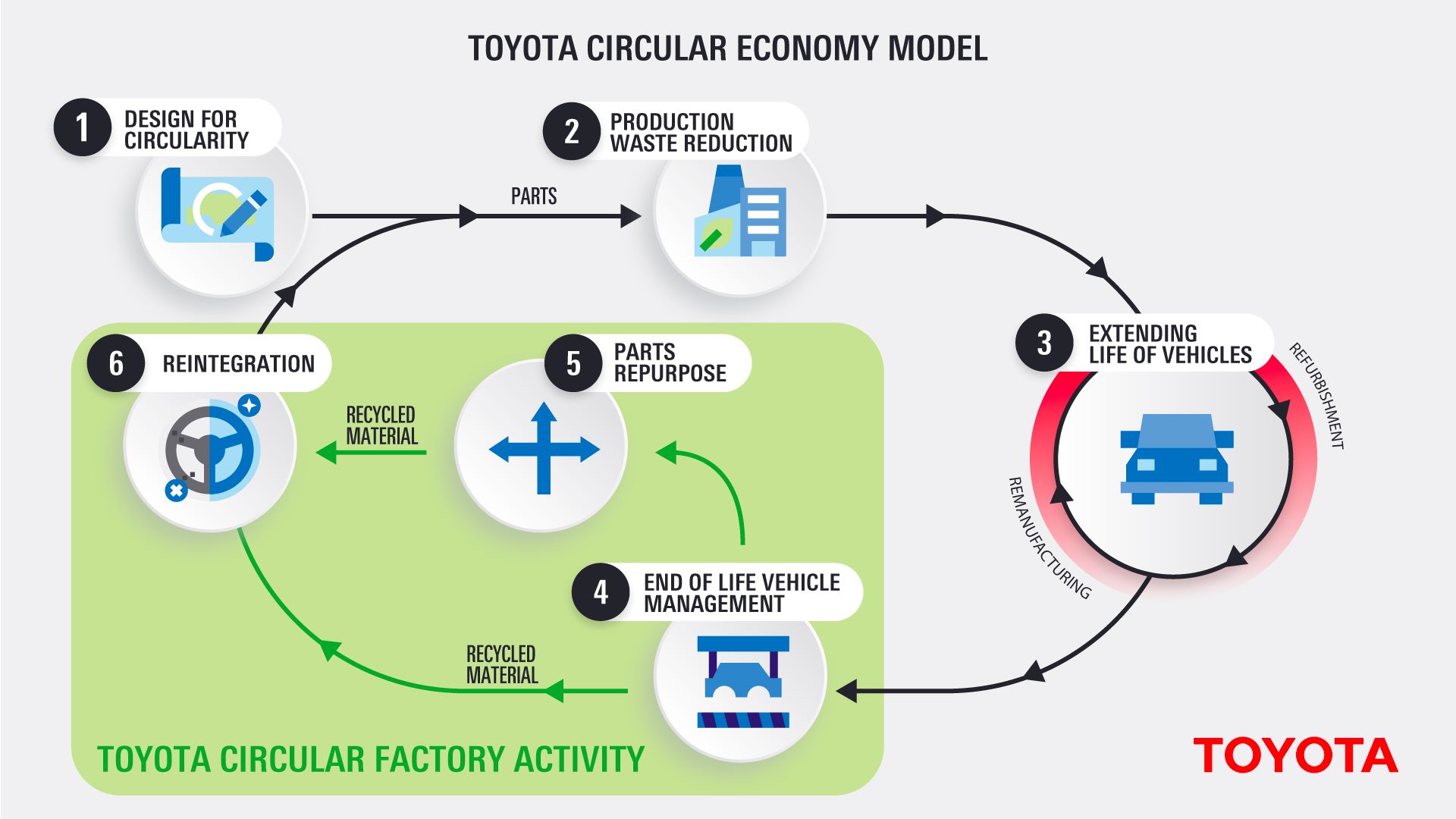
Toyota’s motivations extend beyond environmental stewardship. With Europe moving toward stricter carbon-reduction targets and regulations, including requirements for zero-emission vehicle sales by 2035, enhancing material efficiency is becoming a competitive necessity. The Walbrzych facility supports this shift by integrating end-of-life vehicle processing directly into Toyota’s existing manufacturing ecosystem, which already produces key components for hybrid and conventional powertrains.
For circular economy professionals, policymakers and sustainability strategists, Toyota’s investment offers a real-world demonstration of circular manufacturing at scale. And with leaders like Leon van der Merwe, Toyota Motor Europe’s Vice President for Circular Economy, championing the transformation, the industry will be watching closely.
As Toyota prepares to share its vision with emerging circular economists, the message is clear: circularity is no longer an experimental concept. It is fast becoming the operational backbone of the automotive industry’s low-carbon future.
Staff Writer
Reporting from the front lines of the automotive industry, delivering expert analysis and the technical updates that drive the South African motor sector forward.