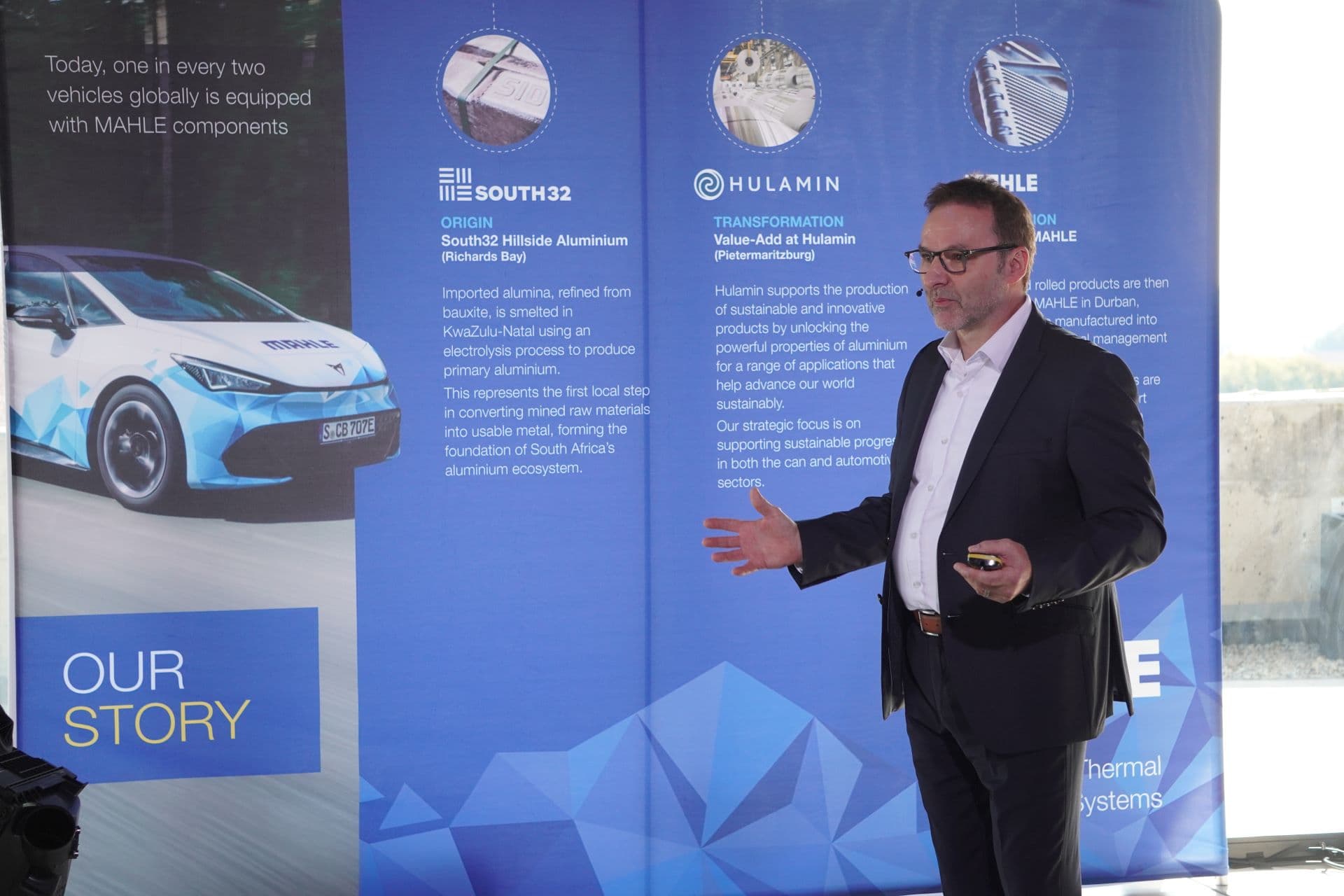
At Mahle South Africa’s International Media Tech Day on 3 June, Managing Director Juergen Wolf delivered a clear message: Africa’s automotive industry is entering a new phase, and South Africa still has an important role to play in shaping it.
Wolf said the continent is moving beyond its long-standing position as mainly an import market. In his view, Africa now has the opportunity to build a more modern, competitive and sustainable automotive industry, supported by a young population, growing urbanisation and rising demand for mobility. He pointed to forecasts suggesting that vehicle production in Africa could reach 5 million units by 2035, creating a major opportunity for manufacturers and suppliers ready to invest.
A short bio of Mahle helps explain why the company believes it can be part of that growth story. Founded in 1920 and headquartered in Stuttgart, Germany, Mahle is a global automotive technology group focused on electrification, thermal management and efficient internal combustion technologies, including solutions designed to lower emissions. The company says its components are found in one out of every two vehicles worldwide. It operates 127 production locations, employs more than 64,000 people and generates annual sales of about 11.3 billion euros. In South Africa, Mahle has operations in Durban and Gqeberha.
Wolf emphasised that many people in South Africa know Mahle primarily as a supplier of air conditioning and engine cooling systems, but that its capabilities go much further. He described the company as a technology partner active across powertrain systems, electrification, thermal and fluid systems, and lifecycle mobility solutions. According to Wolf, this breadth gives Mahle flexibility in a market where no single drivetrain solution is likely to dominate in the near term.
In South Africa, Mahle currently supplies six of the country’s seven vehicle manufacturers and exports close to half of its local revenue, particularly through aluminium tube products shipped to markets including the United States, Mexico, Asia and Europe. Wolf said the company’s South African business already has the structure of a full legal entity with local corporate functions in place, positioning it well for future expansion.
That expansion is already taking shape. Wolf said Mahle plans to widen its local product portfolio beyond its traditional base in thermal systems. New product categories could include air cleaners, oil filter modules, cylinder head covers, acoustic covers and oil pans. He presented this as a practical growth strategy in a flat domestic market: if vehicle volumes are not rising fast enough, suppliers need to increase the range of components they can build locally.
Still, Wolf was candid about the pressures facing the South African automotive sector. He said the country’s production outlook remains flat and far below earlier ambitions, while growing imports from India and China are putting pressure on local manufacturing. He also warned of declining local content, rising regulatory costs for multinationals, and the broader risk of deindustrialisation. Infrastructure has improved, he noted, but scaling up to much higher production volumes would still require stronger logistics capacity.
At the same time, he sees reasons for optimism. New entrants such as Chery, Stellantis and Mahindra could help expand the manufacturing base. The African Continental Free Trade Area could also open new export opportunities from South Africa into key growth markets such as Nigeria, Rwanda, Ghana and Kenya. Wolf described the emergence of a more coordinated pan-African automotive vision as one of the most encouraging developments on the continent.
He also highlighted South Africa’s potential as a services hub, saying the country offers competitive costs, no major time difference with Europe, and strong English-language capability. Mahle, he said, has already begun testing service support from South Africa into Europe and sees room to expand that model.
On sustainability, Wolf said Mahle remains committed to long-term carbon reduction goals, including major cuts by 2030 and carbon neutrality by 2040. But he acknowledged that Scope 3 emissions, especially those linked to supply chains and coal-based electricity, remain a challenge in the local context.
His conclusion was straightforward: Mahle is in South Africa for the long term, but the country cannot take its automotive future for granted. If industry, government and suppliers can align around competitiveness, scale and regional trade, South Africa could remain a critical launch point for growth across the continent.
Staff Writer
Reporting from the front lines of the automotive industry, delivering expert analysis and the technical updates that drive the South African motor sector forward.