Volkswagen’s recent engagement with Egypt has put a renewed spotlight on the carmaker’s long-term intentions in Africa.
The virtual meeting between Egypt’s Vice Prime Minister for Industrial Development, Kamel Al-Wazir, and Volkswagen Brand CEO Thomas Schäfer has raised expectations that Egypt could soon join the small but strategic group of African countries where the German manufacturer already builds vehicles. The discussions outlined a multi-phase plan beginning with contract manufacturing at the Egyptian-German Automotive plant and eventually leading to a fully integrated manufacturing hub in the East Port Said Industrial Zone. For Egypt, this represents not only the prospect of new investment, but a chance to position itself as a gateway to wider regional and continental markets.
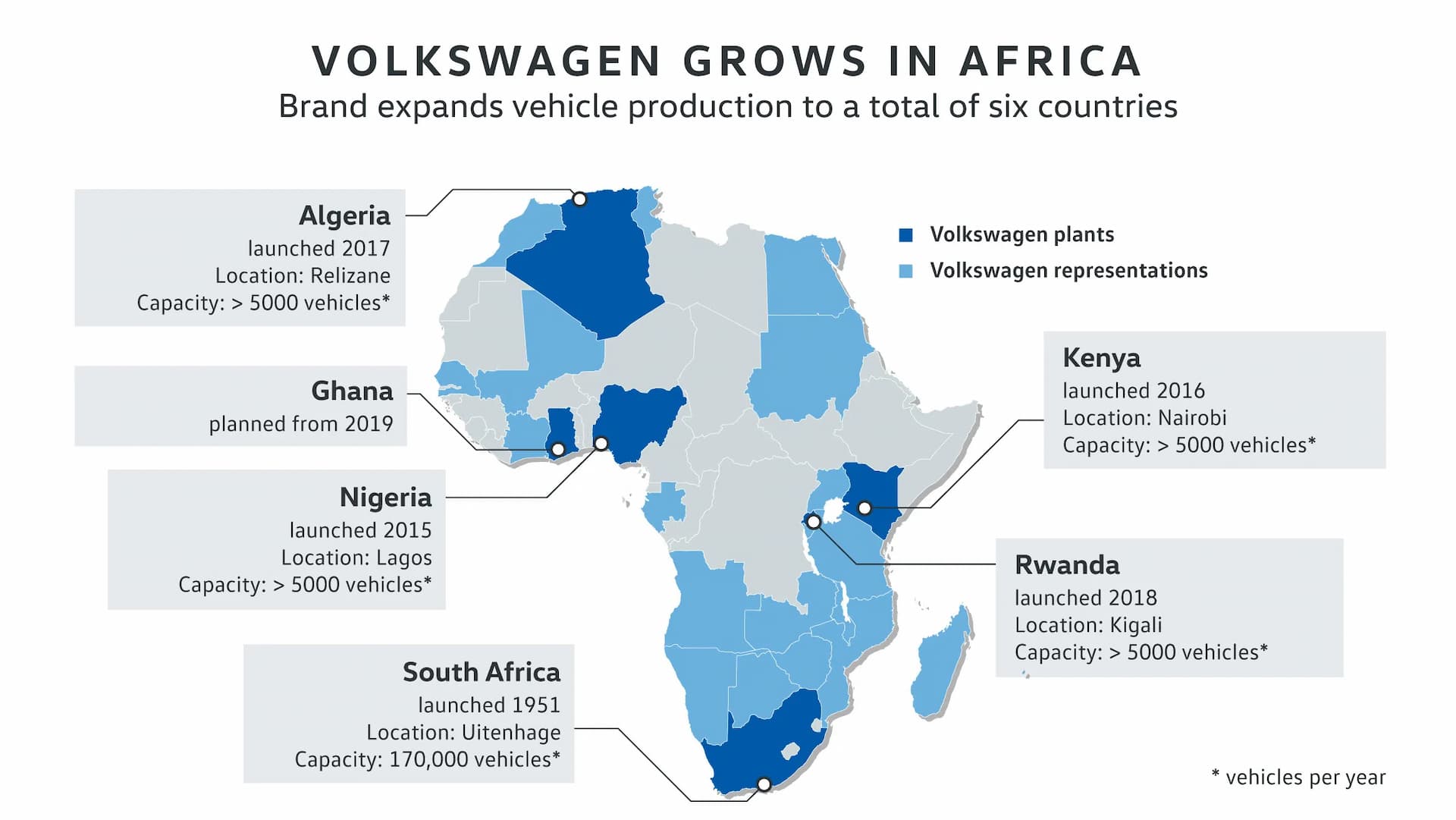
Volkswagen has been steadily expanding its footprint in Africa over the past decade, though South Africa remains its industrial anchor. The Kariega plant in the Eastern Cape, operating since the late 1940s, is one of the company’s most significant production centres outside Europe. The facility manufactures the Polo and Polo Vivo and has recently secured major reinvestment to prepare for an additional model expected before the decade’s end. Beyond South Africa, Volkswagen has established assembly operations in Kenya, Ghana and Rwanda—each reflecting different stages of industrial maturity and market development.
The Kenya Vehicle Manufacturers plant in Thika marked Volkswagen’s return to Kenya in 2016, initially producing the Polo Vivo. Assembly slowed in subsequent years but resumed with fresh momentum and updated models. Ghana joined the network in 2020, becoming one of the first beneficiaries of the country’s automotive development policy, which favours local assembly over used imports. In Rwanda, Volkswagen has taken a more experimental approach, integrating a small-scale assembly plant with a mobility services platform and training programmes aimed at developing local technical expertise. Taken together, these facilities form a patchwork of industrial nodes designed to support both domestic sales and regional exports.
Egypt’s bid to join this network rests on the promise of a more complete industrial ecosystem. The government has committed to support localisation of components, the training of engineers and technicians, and the integration of Egyptian suppliers into Volkswagen’s global value chain. The proposed research and development centre and the specialised technical training facility, including EV maintenance, indicate that Egypt is seeking not merely assembly but meaningful technology transfer. With its strategic location, developed port infrastructure and the incentives offered under the National Automotive Industry Development Programme, Egypt is positioning itself as a potential northern anchor for African automotive production.
Volkswagen’s evolving African footprint also raises the question of its much-publicised electric vehicle ambitions in East Africa. Nowhere has this been more visible than in Rwanda, where in partnership with Siemens the company launched its first electric mobility pilot on the continent in 2019. A handful of e-Golfs and a single charging station marked the beginning of a gradually expanding ecosystem which has since grown to include more vehicles, additional charging infrastructure and government-backed incentives designed to encourage adoption. Rwanda’s proactive policy environment—import-duty and VAT exemptions for EVs, and capped electricity tariffs for charging—has helped make it a continental outlier in the shift towards electric mobility.
Yet the results have remained confined largely to that one market. The challenges that have restrained broader expansion are structural: limited purchasing power reduces consumer demand for new vehicles, let alone electric ones; infrastructure gaps and unreliable electricity supply complicate charging and fleet operations; and local supplier networks are still too thin to support domestic EV manufacture. Volkswagen itself has signalled that in markets such as South Africa, which remains the company’s largest base on the continent, EV production is still at least a decade away, with internal combustion vehicles continuing to dominate both demand and industrial planning.
For East Africa’s EV aspirations, the reality is therefore one of incremental progress rather than large-scale industrial transformation. Rwanda has demonstrated what a tightly focused pilot can achieve, but replicating that model across the region requires deeper infrastructure investment, harmonised policy frameworks and, above all, stronger consumer markets.
This is where Egypt’s ambitions may become significant. A fully integrated manufacturing facility with localised supply chains could give Volkswagen a northern hub capable of serving both African and Middle Eastern markets. The inclusion of EV-related training and the potential for component localisation suggest that the groundwork for future electrification is being laid, even if full EV production remains a medium- to long-term prospect. If Egypt can deliver stable policy conditions, competitive costs and reliable industrial infrastructure, it may become the catalyst that allows Volkswagen to expand its electric vision beyond isolated pilots and into a continent-wide strategy.
For now, Volkswagen’s African journey remains one of pragmatic expansion. The company continues to build on established strengths in South Africa while nurturing newer operations in East and West Africa. Its EV experiments in Rwanda provide valuable lessons, even if they have not yet evolved into large-scale production. Egypt’s entry onto the stage adds fresh momentum and suggests that the next phase of Volkswagen’s African story may be more ambitious, more integrated and more technologically forward-looking than anything seen before.
Staff Writer
Reporting from the front lines of the automotive industry, delivering expert analysis and the technical updates that drive the South African motor sector forward.